THEY DID NOT ARRIVE in the world as the Enigma Variations. When the firm of Novello published the new work in February 1899, the cover of the score read, simply, Variations for Orchestra
, followed by the composer’s name, Edward Elgar, and, in brackets, Op. 36. On the title page this was expanded into Variations on an Original Theme for Orchestra
, and on the next right-hand page came Dedicated to my friends pictured within
. But on the first page of music, the theme itself bore the title Enigma
.
Even that annotation was a late-comer, absent from the score as originally sent for publication. It had been written into the manuscript by Elgar’s editor and confidant A. J. Jaeger, doubtless with the composer’s approval.
The first performance was given on 19 June 1899 in St James’s Hall, London, with Hans Richter conducting. The programme note, by Charles A. Barry, included some of the composer’s own words:
The Enigma I will not explain – itsdark sayingmust be left unguessed, and I warn you that the connexion between the Variations and the Theme is often of the slightest texture; further, through and over the whole set another and larger themegoes, but is not played … So the principal Theme never appears, even as in some late dramas – e.g. Maeterlinck’s L’Intruse and Les sept Princesses – the chief character is never on the stage.
Note that the Enigma (which, following the composer’s example, I shall capitalise) is distinct from the matter of identifying the friends pictured within
. Elgar made that clear in a further programme note for a 1911 performance, by which time the Variations had already acquired a secure place in the concert repertoire:
This work, commenced in a spirit of humour & continued in deep seriousness, contains sketches of the composer’s friends. It may be understood that these personages comment or reflect on the original theme & each one attempts a solution of the Enigma, for so the theme is called. The sketches are notportraitsbut each variation contains a distinct idea founded on some particular personality or perhaps on some incident known only to two people. This is the basis of the composition, but the work may be listened to as apiece of musicapart from any extraneous consideration.
And for 120 years we have listened to what soon became known colloquially as the Enigma Variations – and have been delighted, thrilled and deeply moved by this glorious music. But during that time the meaning of the Enigma has not exactly remained unguessed
. There have been any number of conflicting solutions proposed, without any of them gaining universal acceptance. The interpretation I put forward in this article will certainly not be hailed by all as a definitive resolution of the issue; nor do I claim it as such myself. Yet I believe it is more credible than any previous published theory, and that it leads us into a new understanding of the Variations.
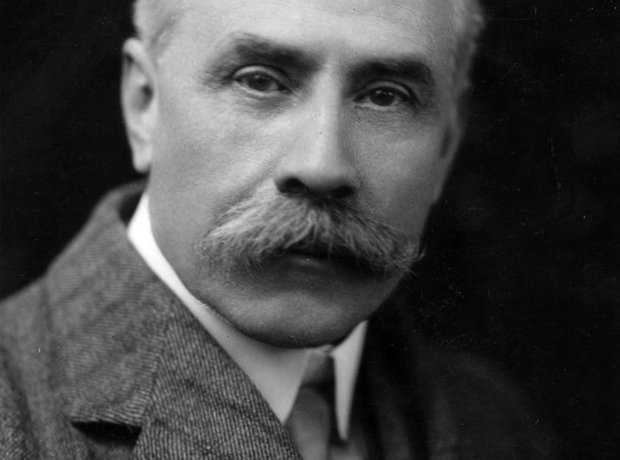
Edward Elgar
The Enigma I will not explain…
– and he never did. Anyone seeking to solve the Enigma today is dependent on the score, on the composer’s programme notes quoted above, and on gleanings from Elgar’s few subsequent writings about the Variations, which do not directly address the nature of the Enigma. There are also remembered and reported remarks he made to friends, and two significant published sources with reasonable claims to be representing his thoughts on the matter. The first is an interview published in the October 1900 edition of the Musical Times, the author being that respected publication’s equally respected editor, F. G. Edwards:
Mr Elgar tells us that the heading Enigma is justified by the fact that it is possible to add another phrase, which is quite familiar, above the original theme that he has written. What that theme is no one knows except the composer. Thereby hangs the Enigma.
The second source is a 1905 biography of the composer written by Robert Buckley with a high degree of cooperation from Elgar. Buckley tells us:
The theme is a counterpoint on some well-known melody which is never heard.
Note that these two statements have a slightly different inference. As described by Edwards, the crucial missing element is a phrase
that is quite familiar
and can be added above
Elgar’s theme. For Buckley this becomes a fully fledged melody
rather than a phrase; it is not just quite familiar
but well known
; and the Enigma theme is now a counterpoint to this melody, rather than a self-standing entity to which a phrase can be added
.
Elgar was careful with his published words, even when he used precision of language to be deliberately ambiguous. But neither Edwards nor Buckley uses direct quotation. If Elgar approved publication of both these texts he would have known that they were at least slightly contradictory; and if his intention was that the Enigma must be left unguessed
, this would have suited him. He was still playing fair, as long as neither author was claiming these exact words had come from the pen or mouth of E. Elgar.
I am making the assumption that playing fair would have been important to Elgar. He was a dab hand at word games and puzzles and at both creating and unravelling ciphers. A chap with that kind of mind, it seems to me, would no more tolerate cheating on his own part than he would from a crossword compiler.
And maybe this is the moment to address one of the factors that has, I believe, led many would-be Enigma solvers astray. Elgar did not construct the Enigma Variations as a gigantic challenge to cryptologists. At no point did he indicate that the work is a labyrinth of abstruse references and allusions, or strewn with musical cryptograms that would point the way to solving the Enigma. First and foremost it is, as he put it, a piece of music
. It was written at a time when his reputation had not yet been secured in Britain, let alone Europe, and he could not have afforded to let any hocus pocus get in the way of creating the finest musical effect. Furthermore, from conception to orchestration the task of composition took a mere three months. This is no Finnegans Wake.
One of the most clear-headed of commentators on the Enigma is the English musicologist Professor Julian Rushton. In his 1999 Cambridge Music Handbook on the Variations he sensibly laid down a series of conditions that any proposed solution ought to acknowledge and satisfy:
1. The solution must unveil a dark saying (although the composer said it
must be left unguessed).2. The solution must find
another and larger themewhich goes over the whole set.3. The solution involves well-known music, or at least something well known.
4. It must be clear why Dora Penny
of all peopleshould guess it.5. [Rushton says this criterion may be
tentatively added] The solution should take into account the characteristic falling sevenths of bars 3–4.
I have already given the background sources for the first three criteria. The final two require explanation. Dora Penny was one of Elgar’s friends depicted in the work. Her variation is No. 10, titled Dorabella
: a playful reference to the character in Mozart’s Così fan tutte, and Elgar’s pet name for her in conversation and letters. In 1937, by which time she was Mrs Richard Powell, she published a book chronicling her friendship with the composer, Edward Elgar: Memories of a Variation. A revised and extended edition followed in 1946. In the 1946 version she devoted a chapter to the Enigma, writing on p. 119:
In November 1899, E.E. chaffed me:
Haven’t you guessed it yet? Try again.
Are you quite sure I know it?
Quite.
And on another occasion:
Well, I’m surprised. I thought that you of all people would guess it.
Why me of all people?
That’s asking questions!
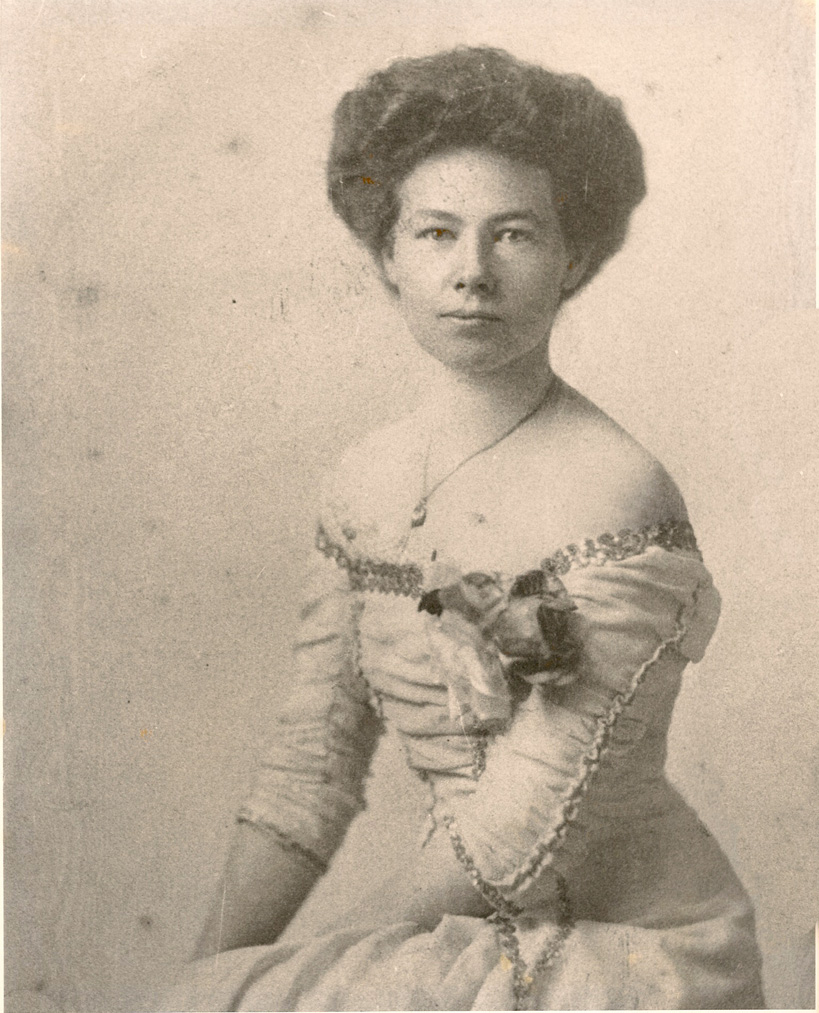
Dora Penny
As for the falling sevenths
cited in Rushton’s (tentative) fifth criterion: as he states, they occur in the third and fourth bar of the Enigma theme. The reason he suggests they should be taken into account is because Elgar asked for them to be observed
when he contributed annotations to a piano roll edition of the Variations published in the 1920s.[1] Reading them in context, it seems to me plain that Elgar is giving the listener guidance on how to follow the progress of the theme as it undergoes the variation process – the falling sevenths, along with the alternation of pairs of quavers and crotchets to which he also draws attention, are the easiest markers to spot. This does not, however, discount the possibility that the falling sevenths are an element in the Enigma as well as in the Enigma theme.
I have now lined up the principal sources of clues to solving Elgar’s Enigma – and I mean to limit my research to them, rather than scouring the score, or Elgar’s (or Maeterlinck’s!) laundry lists, for coded evidence to support an arcane theory of my own. But before embarking on the detective trail we must decide how much of the original theme
applies to the Enigma. Most Elgar authorities appear to agree that the opening section in G minor is the hub of the matter. This is apparently borne out by correspondence between the composer and Jaeger, his contact at Novello, which I have seen cited but have not been able to track down. It would seem to be confirmed by Elgar’s having placed an otherwise rather unnecessary double bar line after the first six bars. As a result, it has often been stated that the Enigma theme is six bars long, which is misleading – to be complete it needs its final note in the seventh bar, where G minor becomes G major. However, it would have been conspicuously unmusical of Elgar to have ruled off his theme with a double bar after the seventh bar, since the last bar of the first section is also the first bar of the second.
Here is the theme:
Fig. 1


Even with the dabbed-in bass line and skeletal harmonisation that Elgar adds, it could easily be taken for a counterpoint to another, missing theme. Friends and family who heard it before publication thought it very odd. The tonic major middle section, which follows before the opening bars return, is much more complete and soothing in effect.
If there really is a well-known
tune to which this is an accompaniment or descant, logic suggests it should be easy to track down. Seven-bar-long themes, or even six-bar-long ones, are rare; the sort of music we are familiar with generally proceeds in units that are multiples of four-bar phrases. Also, conventional melodies are prone to swing from the tonic chord to the dominant and back; Elgar’s theme seems reluctant to make any definite harmonic progress. Thus, there should be few candidates to choose from as a counter-melody.
Yet none of the solutions so far proposed has provided a perfect match. Each has required the candidate for the missing
theme to be cut into pieces, or stretched a bit here and there, or turned upside down or played backwards – and even then the results have failed to provide a literate and convincing musical effect. Some of today’s listeners may feel inclined to accept harmonic clashes here and there for the sake of an ingenious theory, but that is partly because we have become used to irregular counterpoint: the effects we hear in the faux-classical incidental music to films and television programmes, for example. Elgar knew his harmony and counterpoint and, if he had set out to write a countermelody to a well-known tune, it would have fitted perfectly.
Not only have most solutions
been musically unconvincing, but also the theories behind them often seemed so convoluted that I thought a return to common sense might at least be worth trying. So I started back at the beginning, and Elgar’s programme note for the first performance. (All right, that isn’t quite the beginning of the Enigma trail, but I’ll come to the composition history of the Variations a little later.)
The Enigma I will not explain – its
The phrase a dark saying
must be left unguessed…dark saying
could merely be a reference to the matter at hand not being explicitly stated, but given Elgar’s care with language I was more inclined to take both words as containing literal meaning. Then, further, through and over the whole set another and larger theme
That goes
, but is not played…further
separates this theme (to a degree at least) from the dark saying
of the Enigma. But remember that at this stage Elgar had not yet hinted that there was a phrase
or melody
that his theme was a counterpoint to – so further
does not imply that this another and larger theme
is something additional to that phrase. The idea that a second musical theme could somehow be played along with Elgar’s score at any point is plainly unrealistic, so through and over
cannot mean that. But any theme that is intrinsically linked to the Enigma theme is bound to have a presence through and over
the whole set, since that is the nature of variation form.
The description of the unplayed theme as larger
is puzzling, though. In what sense could one theme be larger
than another? The only musical sense in which it could work, as far as I can see, would be if, say, the first note of each variation pricked out another tune that thus went over
the whole set. But that theory must have been tried without success. The use of larger
gives credence to the idea that there is a literary or philosophical theme
underpinning the Variations for Orchestra, and that concept has been explored by several musicological investigators. Yet as we have seen, Elgar was later reported as saying there was an unplayed musical theme involved, and his friends certainly believed that to be the case.
Then we come to the least-often considered sentence in the 1899 programme note: So the principal Theme never appears, even as in some late dramas – e.g. Maeterlinck’s L’Intruse and Les sept Princesses – the chief character is never on the stage.
Elgar was well-read, but the citation of a contemporary Belgian symbolist poet and dramatist in this context is something of a surprise. The reported contents of the composer’s bookshelves are generally more in keeping with his flourishing moustache and military bearing: the novels of Walter Scott, Arthurian legend, Shakespeare, Shelley, Piers Plowman. But he also had an interest in Longfellow and Whitman, and much else besides.
Anyway, it is true that the principal character in L’Intruse never appears: and that character is Death. It is not true, or at least much less true, of Les sept Princesses. The latter concerns a prince who is summoned to awaken seven sleeping princesses. He succeeds with all but the seventh, who turns out to be dead. If any character fails to appear in this play it can only be, once again, Death; but there are plenty of plays in which deaths occur, and it is not usual to describe death’s presence as the principal character
.
Why then did Elgar not just refer to L’Intruse and leave it at that? It would have made his point perfectly well. There must be some reason he directed us to the second play, and if it is something to do with princesses the significance escapes me. But the number seven, now that is interesting…
A dark saying, the omnipresence of death, a seven-bar melody containing two falling sevenths, and an otherwise incongruous mention of a play with seven
in the title. Even at this first stage it struck me that Elgar was pointing to one particular musical work.

Joseph Haydn
Joseph Haydn’s The Seven Last Words of Our Saviour on the Cross was composed for the Good Friday Service at the Oratorio de la Santa Cueva, Cádiz, in 1786. For a new edition published in 1801, Haydn wrote the following preface, which I quote in the translation by Pauline Townsend, from her 1884 biography of the composer:
Some fifteen years ago I was requested by a canon of Cádiz to compose instrumental music on the Seven Last Words of Our Saviour On the Cross. It was customary at the Cathedral of Cádiz to produce an oratorio every year during Lent, the effect of the performance being not a little enhanced by the following circumstances. The walls, windows, and pillars of the church were hung with black cloth, and only one large lamp hanging from the centre of the roof broke the solemn darkness. At midday, the doors were closed and the ceremony began. After a short service the bishop ascended the pulpit, pronounced the first of the seven words (or sentences) and delivered a discourse thereon. This ended, he left the pulpit and fell to his knees before the altar. The interval was filled by music. The bishop then in like manner pronounced the second word, then the third, and so on, the orchestra following on the conclusion of each discourse. My composition was subject to these conditions, and it was no easy task to compose seven adagios lasting ten minutes each, and to succeed one another without fatiguing the listeners; indeed, I found it quite impossible to confine myself to the appointed limits.
These Last Words
of Christ are in fact his utterances from the cross as recorded in the gospels, so as Haydn explains they comprise seven sentences rather than individual words. To the seven slow movements, described in the score as sonatas
, Haydn adds two further movements, an introduction and postlude depicting the earthquake that the gospel writers tell us followed the crucifixion. The original orchestral work was later arranged for string quartet (supposedly by Haydn himself, though doubts have been raised), then piano solo (not by Haydn, but given his blessing) and was finally turned into an oratorio (most definitely by Haydn).
The choral version was much performed in Elgar’s time, usually from the edition produced by his publisher, Novello. Today, however, it is the string quartet version that is most often heard. On (it is thought) Haydn’s instruction, early editions of the quartet arrangement printed the relevant words of Christ, in Latin, under or over the first violin part at the commencement of each movement. This demonstrated that these darkest of dark sayings
correspond to the rhythm and line of the melody first heard in each of Haydn’s sonatas.
Having been led by Elgar to the Seven Last Words, I then set about seeing if any of the melodies fitted with the Enigma theme. Which of Christ’s sayings would the composer have been most likely to relate to? The one that first came to mind was, My God, my God, why hast Thou forsaken me?
(Deus meus, Deus meus, utquid dereliquisti me?).
Elgar was a Roman Catholic, the religion of the seven sacraments, the seven deadly sins, the seven virtues. In the same year that the Variations were published, he began work on his mighty setting for soloists, choirs and orchestra of Cardinal Newman’s poem The Dream of Gerontius. It was a composition of deep personal conviction, but when its premiere failed to impress because of poor preparation, he blamed not the performers or the conductor or the choirmaster but God. I have allowed my heart to open once – it is now shut against every religious feeling & every soft, gentle impulse for ever,
he wrote impulsively to Jaeger. The story of his subsequent relationship with religion and religious music is a complex one that need not be told here; but at the time he wrote the Enigma Variations Elgar was still an observant Catholic.
Nevertheless, his outburst post-Gerontius might suggest that this often disheartened and gloomy artist had previously endured moments of spiritual doubt, hence the case for considering the My God
movement first. What’s more, Haydn’s movement is in B flat, the same key signature as Elgar’s G minor, even though it is in 3/4 time against Elgar’s 4/4. And yet it proved a non-starter: it doesn’t work as a counterpoint, whether you work with the first fiddle phrase or the moment in the oratorio version where the words are sung.
Skipping over unlikely candidates such as I thirst
, the next most probable saying for Elgar to hide in his music seemed to me to be the seventh and last: Father, into Thy hands I commend my Spirit
(In manus tuas, Domine, commendo spiritum meum). This time the key is E flat, and once again we are in triple time rather than quadruple. Here is Haydn’s opening violin phrase, photographed from an early edition, with the unspoken/unsung text below it as per the composer’s instructions.
Fig. 2

We now face the problem of fitting this three-in-a-bar theme to Elgar’s four-in-a-bar (3 + 4 = 7, incidentally: that number again). Here it is, transposed to G minor and augmented to minim = original crotchet, but otherwise with the note and rest values unaltered. I’ve added Elgar’s bass line as it appears in the reprise of the first six bars of the Enigma theme, with sustained notes. The third beat of the first bar feels like a good place to introduce Haydn’s melody, imparting a Bach-chorale-like ambience.
Fig. 3

Well, it starts well enough, but then we get that clash of B flat against B natural in the bass in bar 4. There follows a dissonance between G natural (in Haydn, top line) and A natural (in Elgar) on the fourth beat, though it resolves upwards. The E flat against C sharp in the next bar is piquant, but it resolves nicely onto a unison D. You’ll see or hear that I’ve added a D to the Haydn in the seventh bar, but that’s just because Elgar’s tune already provides the B to complete Haydn’s phrase.
But hang on, why should we have that discordant B flat on the top line in bar 4 anyway? Haydn’s tune was in the major, and we only put it into G minor because that is Elgar’s starting key. If we restore the major third to Haydn’s melody the clash disappears; and while we’re at it we might as well do the same with the E at the beginning of the next bar.
Fig. 4

As the G against A in bar four was a little irksome, I have removed the crotchet rest and extended the G to a minim – a not-unreasonable step if one is fitting a tune in one metre to one in another. Otherwise, the only intervention is to have the Haydn in G minor rather than major in bar six, to match the Elgar tonality.
If the reader thinks that extending the minim is a cheat, then putting the Haydn up an octave to become a descant makes the dissonance more palatable.
Fig. 5

Rather oddly the tune can be combined with the Elgar in several other ways. Here’s one with the Haydn melody entirely in G minor, beginning as an upbeat to the whole thing:
Fig. 6

Obviously the rest between Haydn’s two phrases has been extended here, throwing Elgar’s two falling sevenths into prominence – as if acknowledging that this is the seventh of the seven Last Words?
I also discovered ways of bringing in Haydn’s tune in C minor and even the original E flat, while keeping the Elgar in G minor, though the results were less convincing. While it might appear on the surface that finding multiple almost-fits for Haydn’s melody strengthens its case as the solution, the opposite might be said to apply. It suggests that, with a bit of imagination, it is relatively easy to shoehorn in any tune of your choice. Yet there are particular reasons why the Haydn melody falls into place much better than most others. Rhythmically it dovetails pleasingly because it moves on the beats where Elgar’s theme is static. Unlike most melodies it does not swing on to the dominant after its first phrase. And it is curiously amenable to filling in the very notes needed to create 'correct' harmony.
I can’t resist one more combination of Haydn and Elgar. It deals with only the first phrase of Haydn’s theme
, but I would not discount it for that reason. Unless Elgar had a set of parts for the quartet arrangement of the Seven Last Words, we cannot be sure he knew about the correspondence between the Latin text and the first four bars of Haydn’s sonata. The Enigma theme originated in a piano improvisation, as I shall detail later. If Elgar had been improvising on Haydn’s first phrase, something like this could well have emerged:
Fig. 7

That’s a rather dignified piece of counterpoint, to my ears. Haydn’s first phrase now appears with its original note values rather than in an augmented form, first in G minor, then in B flat major. Then a less literal and augmented version in B flat is heard, smoothing the melody out into a sequence of falling seconds. Rather satisfyingly the Haydn begins on a different beat of the bar each time. It’s entirely speculative, of course. But it shows once again that there is a curious affinity between Haydn’s theme and Elgar’s. Furthermore there’s a hint at the fugal possibilities of Haydn’s phrase – and one of Elgar’s early sketches for the Enigma theme has the annotation for fuga
.
Following Elgar’s working method, as described by his friend and collaborator the violinist W. H. Reed, I have toyed with any number of ways of presenting my material. Actually, there is not necessarily a single definitive
way in which the Haydn is supposed to fit with the Enigma theme. Elgar merely said that the mystery phrase goes
. As I shall explain later, it seems likely that the dark saying
arrived on the scene after the Original Theme had been brought into being. For me, though, Fig. 4 presents the strongest case. There is enough promise here to move on and see how the Haydn solution
matches up to the professor’s criteria – to apply the Rushton Razor
.
1. The solution must unveil a dark saying.
This is clearly fulfilled. The allusion is to the dying words of Jesus – darker and more of a saying
than any other solution.
2. The solution must findanother and larger themewhich goes over the whole set.
I have already alluded to the ambiguity of Elgar’s words. If Haydn’s theme is deemed compatible with the theme on which the Variations are based, it will naturally go
with the whole set. The question of a larger
theme I will come to.
3. The solution involves well-known music, or at least something well known.
How should we define well known
? Likely to be quite well known
to readers of the Musical Times, to cite the context in which the existence of a complementary phrase
was first mooted? Known to a significant proportion of the concert-going public in 1899? Or as well known as, say, Auld Lang Syne or Twinkle, Twinkle, Little Star, to name two solutions put forward in the past? One of the Friends pictured within
, Troyte Griffith, writing to another, Dora Penny, remembered a conversation in 1923 in which he had put forward God Save the King as a candidate. Elgar’s reported reply was, No, of course not; but it is so well known that it is extraordinary that no one has spotted it.
Troyte’s letter was sent fourteen years after the verbal exchange, so we should not assume that every one of Elgar’s words is recalled with total clarity. He might have said, sufficiently well known
rather than so well known
, for example.
I think Haydn’s work The Seven Last Words occupies a respectable place within the spectrum of quite well known
to so well known
. It is a masterpiece by one of the greatest and most famous of classical composers, and the choral version in particular was regularly performed during the golden age of choral music in Britain. The Gramophone reviewer of a 1992 CD version wrote, As the yellowing Novello scores in many a second-hand music shop testify, the oratorio version was something of a favourite with Victorian and Edwardian choral societies.
4. It must be clear why Dora Pennyof all peopleshould guess it.
In her book, Dora Powell (née Penny) writes, I am sure E. E. would not have expected me to guess it if it had been an idea and not a tune. I was so mixed up with tunes in those days; Choral music, Church music, and orchestral music – and then my own solo singing…
Very much Elgar’s junior, Dora had a conversational and epistolary relationship with the composer that was conducted in a rather embarrassing mixture of baby-talk, word-play and the slang of their era. It is therefore not a clear-cut matter that we outsiders should know why she of all people
might guess the Enigma – it could well be something to do with a private joke or shared experience. However, as she says, she was heavily involved in choral singing; and thus was likely to have sung the Seven Last Words at some time. She ran her own string orchestra, which might have played the quartet version. Furthermore she was the daughter of a clergyman and came from a family steeped in mission work and church matters – and she would eventually marry a clergyman. So in many ways she of all people
might be expected to make the connection with Christ’s words and with Haydn’s score.
5. The solution should take into account the characteristic falling sevenths of bars 3–4.
Two falling sevenths in a seven-bar theme; the seventh of Christ’s seven words.
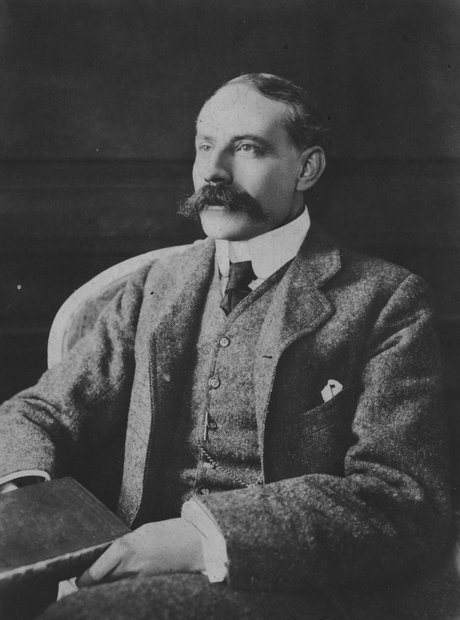
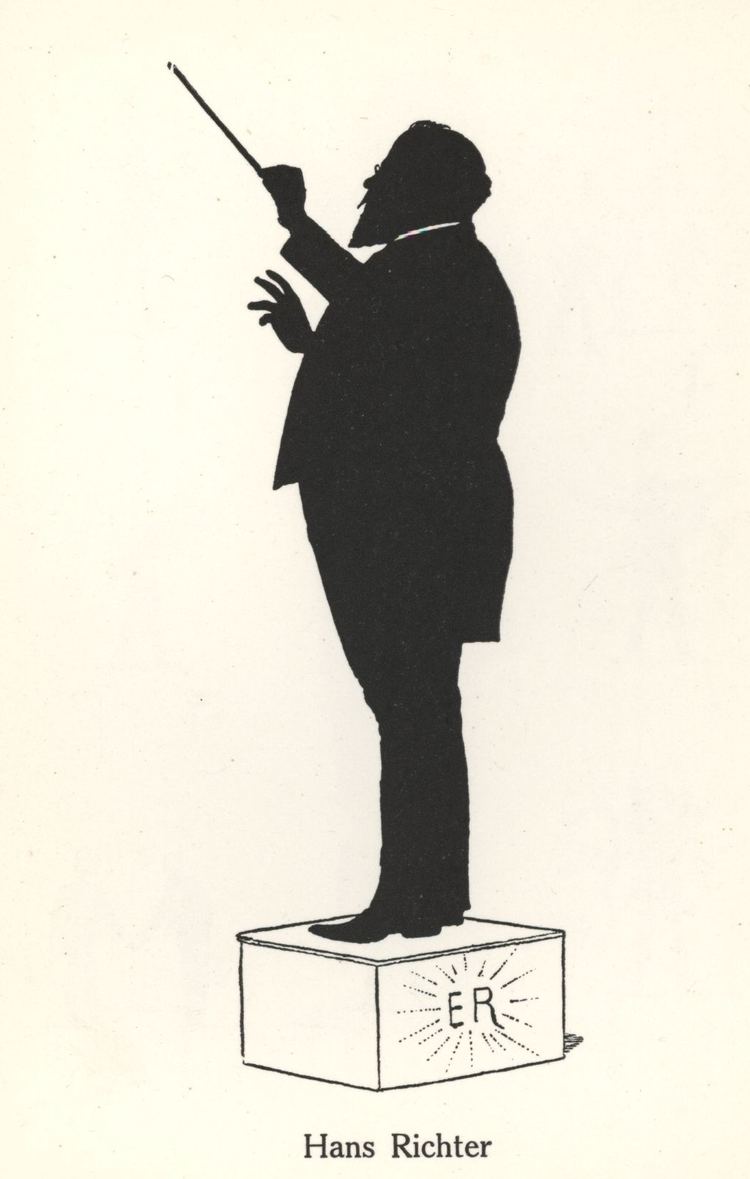
The composer of the Variations and their first interpreter
The real Enigma begins here. Why would Elgar choose this dark saying
, and how does it relate to his friends and the Variations as a whole? That, surely, is our larger theme
.
The phrase Father, into Thy hands I commend my spirit,
might, at a stretch, be thought of as a simple declaration of faith – Elgar dedicating his score to his God just as another devout Catholic, Joseph Haydn, used to preface his manuscripts with in nomine Domini
(in the name of the Lord) and sign them off with Laus Deo
(praise be to God). But I cannot imagine Elgar taking such a superficial view of the Saviour’s final utterance at the very point of His death. So, why would the composer commence the Variations with last words
? It is hard to see how the crucifixion could be related to a series of depictions of friends, several of them humorous in effect, followed by a rumbustious self-portrait.
If Elgar was expressing his own mood with these words, the conclusion would be that he was preoccupied with thoughts of his own death. That hardly seemed likely in a forty-two-year-old composer, but it was an idea that deserved to be explored. It is well known that the composer was subject to self-doubt and episodes of depression, but dark thoughts
of such a personal kind had not, to my knowledge, been associated with the Variations before.
A little research confirmed that Elgar’s depressions could, indeed, lead him into confessing suicidal thoughts. After the disappointing premiere of Gerontius in 1900, he described himself in a letter to Jaeger as at the end of my financial tether … I really wish I were dead over & over again – but I dare not, for the sake of my relatives, do the job myself
. The music critic Ernest Newman took dinner with the composer and his wife, Alice, in 1902. He later described how Alice tactfully steered the conversation away from the topic of suicide that had suddenly arisen; she whispered to me that Edward was always talking of making an end of himself
.
We can get a fairly clear impression of his state of mind when bringing the Enigma theme into being, since the story of its origin has been told many times. It is worth prefacing that story with an extract from a letter he wrote to Jaeger on 20 October 1898. His cantata Caractacus had just been performed in Leeds to general acclaim; Jaeger had clearly written a letter of congratulation and expected to find the composer in high spirits. Elgar replied as follows: No – I’m not happy at all in fact never was more miserable in my life: I don’t see that I’ve done any good at all: if I write a tune you all say it’s commonplace – if I don’t, you all say it’s rot.
After some routine complaining from a composer to his publisher about fees, he adds, No thank you – no more music for me – at present…
The day after writing that letter Elgar spent what he regarded as a gruelling day’s work teaching violin at The Mount, a girls’ school in his home town of Malvern. It was a thorn in his side that he did not earn sufficient income from composing to escape from these duties. In one of those quotes from Elgar that turns up regularly without the source being named, he supposedly described teaching as like turning a grinding-stone with a dislocated shoulder
.
When he reached home he would probably have whistled the four-note phrase through which he normally announced his arrival – an affectionate signal to his wife, which he would work in to her variation as well as the finale. The composer’s own description of what happened next has been appearing in Elgar biographies since the 1930s, though once again its precise source is unclear:
After a long day’s fiddle teaching in Malvern, I came home very tired. Dinner being over, my dear wife said to me,
Edward, you look like a good cigar,and having lighted it, I sat down at the piano…In a little while, soothed and feeling rested, I began to play, and suddenly my wife interrupted by saying:
Edward, that’s a good tune.I awoke from the dream.Eh! Tune, what tune!And she said,Play it again, I like that tune.I played and strummed, and played, then she exclaimed:That’s the tune.
He continued playing.
The voice of C. A. E. [Caroline Alice Elgar, his wife] asked with a sound of approval,What is that?I answered,Nothing – but something might be made of it.
Feeling ever-more relaxed he started to play the nothing
tune in different ways, and Alice realised that the quirks and characteristics of some of their friends were emerging from the improvisations – a slammed door, a distinctive laugh. It became a game, with Elgar asking Alice to guess which of their acquaintances he was conjuring up. The game continued over the next few days, sometimes with the friends themselves brought in to see if they recognised themselves or each other. In rapid time the work, commenced in a spirit of humour
as Elgar wrote in his 1911 programme note, was continued in deep seriousness
, and the Variations for Orchestra came into being.
But the deep seriousness
would have been there from the beginning if Elgar had been improvising on a theme from Haydn’s Seven Last Words. It is possible in theory that the Haydn melody was in his head and he was playing just the counterpoint, which Alice mistook for a tune in its own right – but would he immediately have subjected something of such gravity to such jokey treatment? Elgar scholars have suggested that the improvisation was based on phrases from Mozart’s Prague Symphony or a tune from Elgar’s own Caractacus, but it might just as easily been idle strumming. There is certainly no mention of a countermelody in the composer’s own account of the Enigma theme’s genesis, let alone of a dark saying
.
Yet by the premiere in 1899 the Enigma Variations had acquired the concepts of a riddle (the dark saying) and a mystery (the larger theme) within them. At what stage had these intriguing complications arrived? I began this essay by pointing out that there was no mention of an Enigma when the score was submitted to Novello. So we have a wide time-frame.
We have no way of knowing how much changed between the improvisation of 21 October 1898 and the finished Original Theme
of the Variations. At some stage Elgar could have had the idea of adapting the theme, slightly, to make it a counterpoint to Haydn’s.[2] Or maybe it was a coincidence that it fitted, something he spotted as he was working on the score. It is even possible (though highly unlikely) that he did not realise that the two tunes could be combined until after the manuscript had been sent off for publication. What we can be certain of is that, until he authorised Jaeger to add the word Enigma
over the theme, he had no intention of setting his listeners a puzzle.
Could it have been that he changed his mind only after lobbying from Jaeger? Jaeger knew the Enigma’s secret – or at least he knew what the hidden melody was. When Dora Penny put pressure on him to reveal it, he replied, Now, Dorabella, you must be a good girl and not ask me about that. I do not suppose that I could keep it from you if you were to plead with me, but the dear E. E. did make me promise not to tell you.
[3]
Jaeger (and, indeed, the composer) may have assumed that adding an air of mystery to the first performance of this new work might attract more attention to it. Elgar was desperate for a breakthrough and a larger public, and his contact at Novello would have seen the mutual advantages of courting publicity. As it turned out, the critics at the premiere appear to have been irritated by the teasing nature of the Enigma business, though full of praise for the work itself. If Elgar and Jaeger were playing the long game, though, the ploy clearly worked.
A. J. Jaeger makes such frequent appearances in the Enigma story that it is worth pausing to give him a proper, if belated introduction.
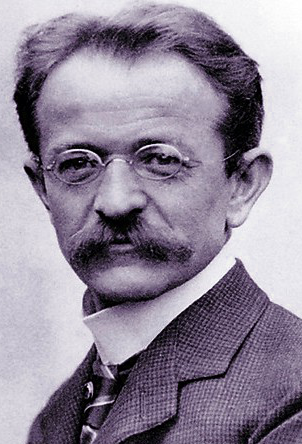
A. J. Jaeger
Born in Düsseldorf in 1860, August Johannes Jaeger moved to London in 1878 and joined the music-publishing firm of Novello in 1890. He first met Elgar in 1897, and their immediate good relationship flourished to the extent that he was soon able to offer constructive criticism without the thin-skinned and easily discouraged composer taking serious offence. It was at Jaeger’s suggestion that the finale of the Enigma Variations was considerably (and magnificently) extended after the first performance. In 1905 Jaeger was diagnosed with tuberculosis, and subsequent poor health prevented him from working from that time until his death in 1909. Yet he continued to be a close friend of the composer.
In 1907 he wrote in a letter to Dora Penny, I have worked terribly hard for E. E. and ruined my health over it very likely… I have never loved & admired a man more, made myself more a slave for any man out of sheer enthusiasm.
As many readers will know, Jaeger is Nimrod
, the ninth and most famous of the variations. Jäger means hunter
in German, and Nimrod is the name of a mighty hunter
in the biblical books of Genesis and Chronicles – typical Elgarian word-play.
Dora Penny had not yet met Jaeger when she first heard Nimrod
; from the music she formed a picture of an especially high-minded and imposing gentleman. She was therefore puzzled when the man himself turned out to be entirely approachable, with his volubility and his amusing – almost racy – turn of phrase. I was greatly puzzled. Surely this Variation could not be a portrait?
Indeed it was not. As Elgar explained in his 1911 programme note, The sketches are not
In his commentary for the piano roll edition, which later formed the basis for a book, My Friends Pictured Within, Elgar wrote:portraits
but each variation contains a distinct idea founded on some particular personality or perhaps on some incident known only to two people.
Something ardent and mercurial, in addition to the slow movement (No. IX), would have been needful to portray the character and temperament of A. J. Jaeger (Nimrod). The variation bearing this name is the record of long summer evening talk, when my friend discoursed eloquently on the slow movements of Beethoven, and said that no one could approach Beethoven at his best in this field, a view with which I cordially concurred. It will be noticed that the opening bars are made to suggest the slow movement of the Eighth Sonata (Pathétique).
This evocation of a pleasant chat on a summer evening fits in well enough with the familiar, rather cosy impression most listeners have of the Enigma Variations: a theme followed by a series of affectionate impressions of good friends, concluding with a (somewhat immodestly impressive) finale. So does the other well-known incident
within the variations, a musical depiction of Dan, the pet bulldog of the Hereford Cathedral organist George Robertson Sinclair, falling into the river Wye and scrambling out again (Variation XI, G.R.S.). But if we read Dora Penny’s version of the long summer evening talk
between Elgar and Jaeger, something altogether darker and more significant emerges. In August 1904, sensing that the composer was in an unusually talkative mood, she asked him:
Why did you give Mr Jaeger such a grand and noble tune?
Don’t you think him grand and noble? His mind is! ButNimrodisn’t really a portrait; it is the story of something that happened… I was very down in the dumps; everything seemed to be going wrong. I was feeling pretty wretched and I told him I was going to give it all up and write no more music.(I could not help smiling. I had had a letter from E. E. myself in which he said he was sick and tired of mouldy music and was going to take up kite-flying! Of course I knew he didn’t mean it and that everything would be all right again soon, but one could quite imagine that a foreigner might not so easily understand.)
E. E. went on: ‘He wrote me such a screed, reams and reams of it, all about my ingratitude for my great gifts, as he called them, and he abused me for my wickedness – and I don’t know what else! Then he finished at last by suggesting that he should come down and talk it all over with me. Of course he came, and we went out for a long walk. Then he went at it again, hammer and tongs, and he preached me a regular sermon and sang Beethoven at me!
…He said that Beethoven had a lot of worries, and did he give it all up? No. He wrote more, and still more beautiful music –And-that-is-what-you-must-do.So he won the day… I am certain that he thought he had saved a critical situation by doing so.When E. E. had finished this story he turned to me and said gravely:
You must never let him know that I have told you all this. Now promise me, Dorabella,holding up a commanding finger.
Elgar quoted Nimrod
in his 1912 setting of Arthur O’Shaughnessy’s poem The Music Makers. It occurs at the words:
But on one man’s soul it hath broken,
A light that doth not depart;
And his look, or a word he hath spoken,
Wrought flame in another man’s heart.
He also quotes the Enigma theme at the very beginning of The Music Makers. He explained in a letter to Ernest Newman, I have used the opening bars of the theme because it expressed when written (in 1898) my sense of the loneliness of the artist as described in the first six lines of the Ode, and to me, it still embodies that sense.
Those six lines are:
We are the music makers,
And we are the dreamers of dreams,
Wand’ring by lone sea-breakers,
And sitting by desolate streams;
World-losers and world-forsakers,
On whom the pale moon gleams…
It is not the only evidence that Elgar felt a strong sense of identification with the Enigma theme. Its first four notes correspond to the spoken rhythm of his name, and he took to writing that phrase at the end of letters instead of a signature.
The implication of this is that we have not one but two depictions of Elgar in the Enigma Variations: in the theme itself, which expressed when written … the loneliness of the artist
, and in the finale, as the most confident, hearty and optimistic of Englishmen. And at the emotional heart of the set we have Nimrod
, the recollection of a crucial conversation that helped to bring about the transformation.
If the account of that conversation that Elgar gave to Dorabella is on a deeper level than the version he offered the public in the annotation to the piano roll, then we can infer a still-deeper level of seriousness from his insistence that she should keep it secret. I am certain that he thought he had saved a critical situation,
said Elgar of Jaeger’s dash from London to Worcestershire. If Elgar was always talking of making an end of himself
as Alice told Ernest Newman, it is a logical conclusion that such statements came out at the moments when he could see no viable future for himself as a composer – and those moments were frequent, especially before the success of the Enigma Variations. Could he go on living without writing music? It was certainly not the threat of his taking up kite-flying that brought Jaeger to Malvern in such haste.[4]
Given the narrative for the Variations that is emerging, the case for associating the phrase Father, into Thy hands I commend my spirit
with the Enigma theme strengthens. To be or not to be
becomes not just the question but the Enigma. But how do we relate this dark saying to the variations other than Nimrod
? It is time to consider another sentence from the 1911 programme note: It may be understood that these personages [the friends] comment or reflect on the original theme & each one attempts a solution of the Enigma, for so the theme is called.
Let’s pick this apart. Comment or reflect on the original theme…
This is perhaps a generalised way of describing how the theme is allowed to take on the characteristics of the friends. When Elgar wrote to Jaeger on 24 October 1898 to tell him the gist of the score he was already working on, he wrote, I’ve liked to imagine the
The idea that he was imagining his friends as amateur composers is a great deal more specific – too specific in fact to apply to all the variations.party
writing the var: him (or her) self & have written what I think they wd. have written – if they were asses enough to compose…
Then we come to each one attempts a solution of the Enigma…
This is altogether more intriguing. If the Enigma (which must be left unguessed
) is linked to thoughts of suicide, we can hardly imagine Elgar asking each friend in turn whether the composer should take his own life; nor can we imagine him setting all their responses to music; and what has a bulldog falling into the river got to do with attempting a solution of the Enigma
?

G.R.S. and Dan
I think I can tie everything together in a single story.
On 21 October 1898, the forty-two-year-old Edward Elgar was (not untypically) at a low ebb. As a composer he had experienced some commercial success with pot-boilers and miniatures, but this in itself distanced him from the musical establishment. For example, his recently published Chanson de nuit had been haughtily dismissed by the critics. More ambitious works such as Caractacus seemed unlikely to make any impact outside his local area. As a Catholic, a provincial musician and the son of a tradesman he regarded himself as an outsider, and believed (with some justification) that there was prejudice against him. Teaching was the bane of his life. On several occasions he had asked friends whether it was worth going on. Or at least he had told them he intended to give up his musical ambitions, and waited to see their reactions. To his wife, and to his very closest friend, he confessed that the idea of abandoning music made him feel suicidal. Was he simply seeking reassurance, or was he seriously contemplating taking his own life?
When he returned home from teaching that day in October, Alice Elgar could see the strain on his face – hence her suggestion that he could do with a good cigar. She further tried to coax him out of his depression by commenting approvingly on something that caught her ear as he improvised distractedly at the piano. Elgar himself was unaware that he was even playing a tune. It was nothing
– though now Alice had drawn his attention to it, he saw it had possibilities. And so began the game of playing it in the style of
some of their friends and acquaintances.
Three days later he was writing to Jaeger to say that he had already sketched out a set of orchestral variations, each of which carried the nickname of a particular friend. Even at that stage he could confirm that you are Nimrod
. Clearly he was in much improved spirits. Work continued with speed and enthusiasm.
Jaeger’s variation turned out to be not a portrait of his friend but a record of the conversation between them when – in the mind of at least one of the two friends – the composer had seriously been contemplating suicide. At some stage he realised that the opening melody of the final sonata from Haydn’s Seven Last Words of the Saviour was a close fit as a countermelody to his theme – a hidden acknowledgement to Jaeger and himself that death was indeed a tangible presence in that original theme that expressed when written my sense of the loneliness of the artist
.
This suggested a loose narrative structure to the Variations, a larger theme
. By conjuring up his friends, and remembering how they had coped with his changing moods, he was tracing a path – between the sombre sense of isolation he had been feeling and the new confidence that had come to him through work on this major orchestral project. Those friends had not always been aware how much a remark or an incident in their company had affected his outlook. Remember that occasion when Dan the bulldog fell into the Wye and the ensuing laughter had renewed his zest for life? And as for those Job’s comforters who had hinted that E. Elgar might have more success pursuing a different career, he’d damn well show them, with a defiant and exhilarating finale! And in that finale he would pay special tribute to the two people who had truly given him the support he needed: Alice Elgar and August Jaeger.
The completed score was sent off to Novello to be published as Variations for Orchestra, dedicated to My friends pictured within,
with only the composer and Jaeger (and probably Alice Elgar) knowing there was a hidden phrase and a hidden narrative. But before it went into print, Jaeger’s commercial instinct came into play; a touch of intrigue might garner attention. He and Elgar came to an agreement that the word Enigma
would be added above the theme, and that before the premiere Elgar would offer some hint of its significance without giving away the secret. Elgar was, after all, a master at appearing to reveal information while simultaneously adding a new layer of concealment…
Everything in this story is evidence-based, with the exception of the involvement of the Haydn theme, and my speculation on how Dan the bulldog fits in with my interpretation of the larger theme
.
The harrumphing reader may protest that the idea of the narrative
is itself speculation. Indeed, when I arrived at it I thought so myself. But when subsequently I looked at Elgar’s piano-roll annotation for the finale I have to say the hairs rose on the back of my neck.
FINALE: bold and vigorous in general style. Written at a time when friends were dubious and generally discouraging as to the composer’s musical future, this variation is merely intended to show what E. D. U. (a paraphrase of a fond name)[5] intended to do. References made to Var. I (C. A. E.) and to Var. IX (Nimrod), two great influences on the life and art of the composer, are entirely fitting to the intention of the piece.[6]
The whole of the work is summed up in the triumphant, broad presentation of the theme in the major.
If I had ever read that before I started thinking seriously about the Enigma, it was a long time ago and I had forgotten it. And if I had read it, my first thought would probably have been to register how ungracious Elgar sounds. Nor does what I feel I now know about the Variations entirely dispel that impression. However he perceived it, it seems highly unlikely that any of his friends set out to discourage him. He was the one always threatening to give up mouldy music
; if they got fed up with him banging on about it all the time and began to wonder if it might not be such a bad idea after all, who can blame them?
That aside, this passage seems to establish beyond doubt that Enigma Variations’ larger theme
– or at least the intention of the piece
– is telling how Elgar recovered from depression with the help (and sometimes hindrance) of his friends pictured within.
Back to the question of the hidden theme. The evidence suggests it is likely that its insertion (or discovered presence) came after Elgar’s Original Theme had taken shape. Whether it became necessary to adapt his theme to accommodate it, we can’t know. If his original intention had been to write a counterpoint to a well-known tune, we would expect a perfect and obvious fit. But in the circumstances I have faith in my Figure 4, with only the slightest adjustments having been made to achieve a very satisfying result. It will maybe convince anyone prepared to accept the link I perceive between Elgar’s programme note and Haydn’s Seven Last Words.
With the hypothetical hindsight that this affords, the clues Elgar offered at the first performance seem rather recklessly plain if he wanted the Enigma to remain unguessed
. But at that time he had not spelt out an explicit connection between the Enigma theme and a quite familiar
phrase that could be played in counterpoint. I suppose he bargained that anyone looking at the right place in the Haydn score would assume that three beats into four beats wouldn’t go. And 120 years would seem to have proved him right.
*
I do not wish to set myself up as the latest figure cast in the role of the person who claims to have solved Elgar’s Enigma
. Identifying oneself with a theory is a sure way to fall into the trap of cognitive selection bias, and seeing only the evidence that supports one’s proposition. Furthermore I have no reason to think of my suggested solution as a clever one – quite the opposite, since I believe the lack of cleverness is the strongest element in its favour. I just went straight in the direction I thought Elgar was pointing me.
When researching the available material I deliberately looked for anything that could rule out the choice of the Haydn phrase as the hidden tune. Comfortingly, I have not succeeded in doing so. But I believe I have applied not just Rushton’s but also Occam’s Razor to the extent that an outbreak of shaving rash would seem imminent.
I have also avoided addressing other people’s theories about the theme, other than those circulating among Elgar’s friends. The many that have followed, and the evidence assembled in their favour, can be judged alongside and against my presentation.
As for the guesswork that went on in the composer’s lifetime, Dora Penny seems to have come rather late to accepting what Elgar had said at the start: …as years passed I came to have the feeling that he did not want the solution found, and as time still further went on and no one guessed it he determined never to divulge it himself
. The Penny’s dropped, so to speak. She goes on: He always changed the subject at once if any one began it. I believe that the only two people who shared his confidence were the Lady [Alice Elgar] and Mr Jaeger.
Professor Rushton suggests that Elgar became increasingly discouraging of Enigma detective work as time passed, because of his social and artistic advancement. He might have been embarrassed, posits Rushton, if it turned out that his masterpiece was based on a tune considered trivial. Although Jaeger lived for only a decade after the premiere of the Variations, he learnt to divert enquiries about the hidden theme by dismissing them as one of Elgar’s japes
, which on the surface implies that the tune is of popular origin.
But the opposite could be true: the dark saying is so dark that Elgar meant exactly what he said when he wrote that it must remain unguessed
. Confessing thoughts of suicide would be a very serious matter for a Catholic, especially once that person had become a public figure. And it would be just like the loyal Jaeger to protect his friend by sending people off in the wrong direction.
The idea that the Enigma Variations outline the composer’s recovery from suicidal depression is an emotive one. It contrasts starkly with the conventional view of the work as a warm-hearted paean to friendship. In cold analytical terms, however, the theory need not address the question of whether Elgar really was suicidal or whether he just wanted reassurance. In his mind at the time, giving up music meant surrendering the will to live.
Despite my efforts to be objective about the Haydn theory, I have to admit that I couldn’t help identifying with it in one particular sense. The more I researched, the more inevitable it seemed that I would discover that someone else had put it forward. And if the theory had vanished from the literature, it must surely have been roundly rejected, and my work on it would have been in vain. But I have yet to turn up any mention of it, which seems astonishing. The hints towards it in Elgar’s programme notes are obvious enough to be worth investigating, surely. Haydn is a very well-known composer indeed, and the oratorio version of his Seven Last Words of Our Saviour on the Cross was a staple of the choral repertoire at the close of the nineteenth century. In any guise it is one of Haydn's most important works. In fact, it is so well known that it is extraordinary that no one has spotted it
.
* * *
[1]Before the recording industry got fully underway, music was often heard in the home via mechanical pianos that worked the keys via specially prepared rolls of paper.
[2]For clarity of argument I am here assuming that the Haydn melody is the hidden tune, but the points made apply even if the reader rejects that idea.
[3]Page 28 of Dora Powell’s book.
[4]It has been proposed that the falling sevenths in the Enigma theme are a reference to the slow movement of Schumann’s Second Symphony, and thus obliquely to Jaeger, by way of his birthplace, Düsseldorf. However, the symphony was composed before Schumann moved to Düsseldorf. What seems more significant is that the symphony represented to its composer his own journey from suicidal depression to renewed optimism.
[5]E. D. U. is a pun on Edoo
, the pet name that Alice Elgar (C. A. E.) had for her husband.
[6]My italics.
Brian David is a freelance writer and editor living in the UK. He is a frequent writer of programme notes for Wigmore Hall and other venues, and is a critic for Opera Canada magazine.
SELECT BIBLIOGRAPHY
Kennedy, Michael, The Life of Elgar (Musical Lives), Cambridge University Press, 2004
Moore, Jerrold Northrop, Elgar: A Creative Life, Oxford University Press, 1984
Powell, Mrs Richard [Dora Penny], Edward Elgar: Memories of a Variation, Remploy Reprint Edition of 1946 revision, 1979
Reed, W.H., Elgar as I Knew Him, Gollancz, 1936